

1980
Kamehameha School’s (KS) 40 years of pasture leases to the Robinson family ends and they begin planning resort development for Waipā and Lumaha’i.
1982
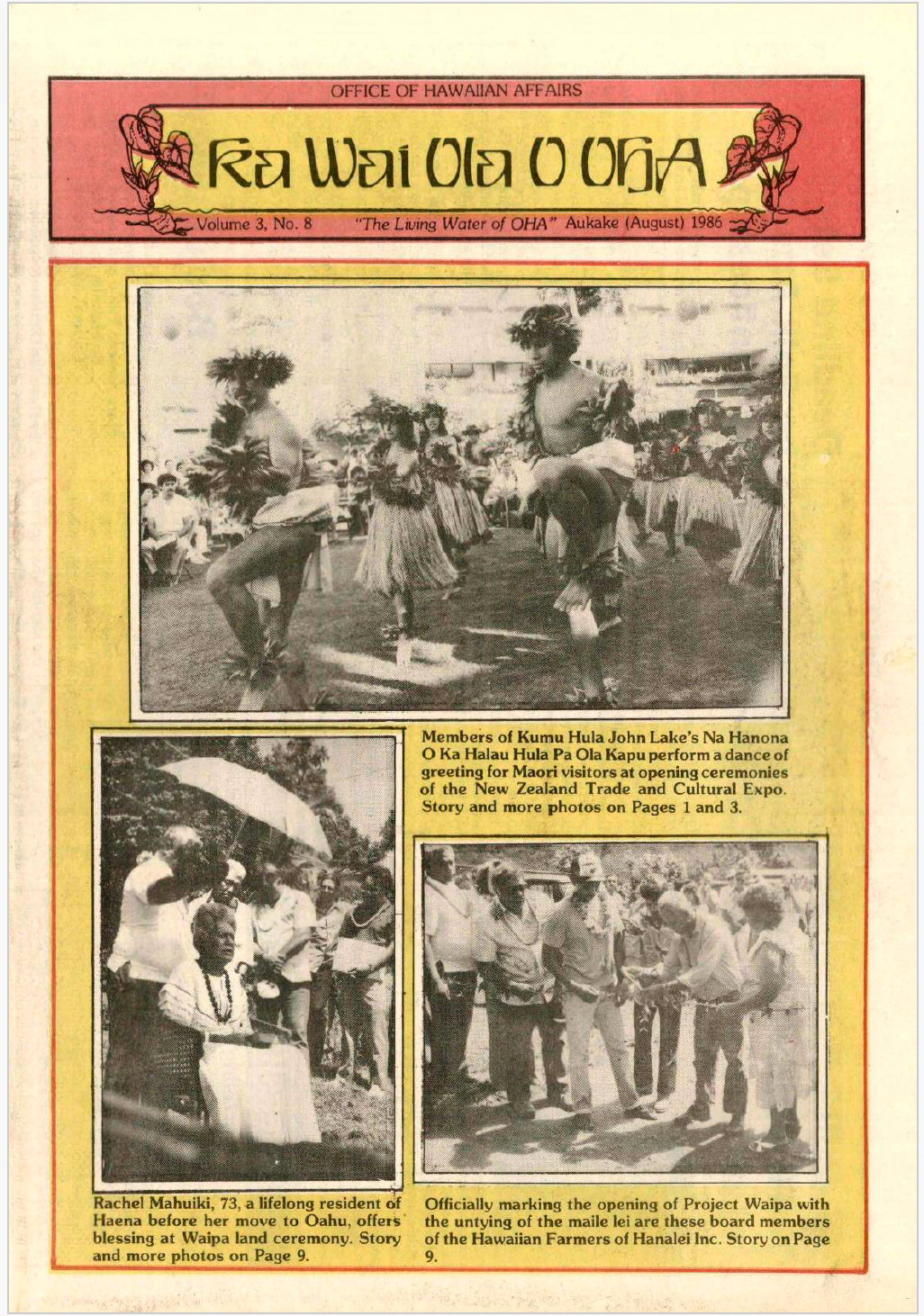
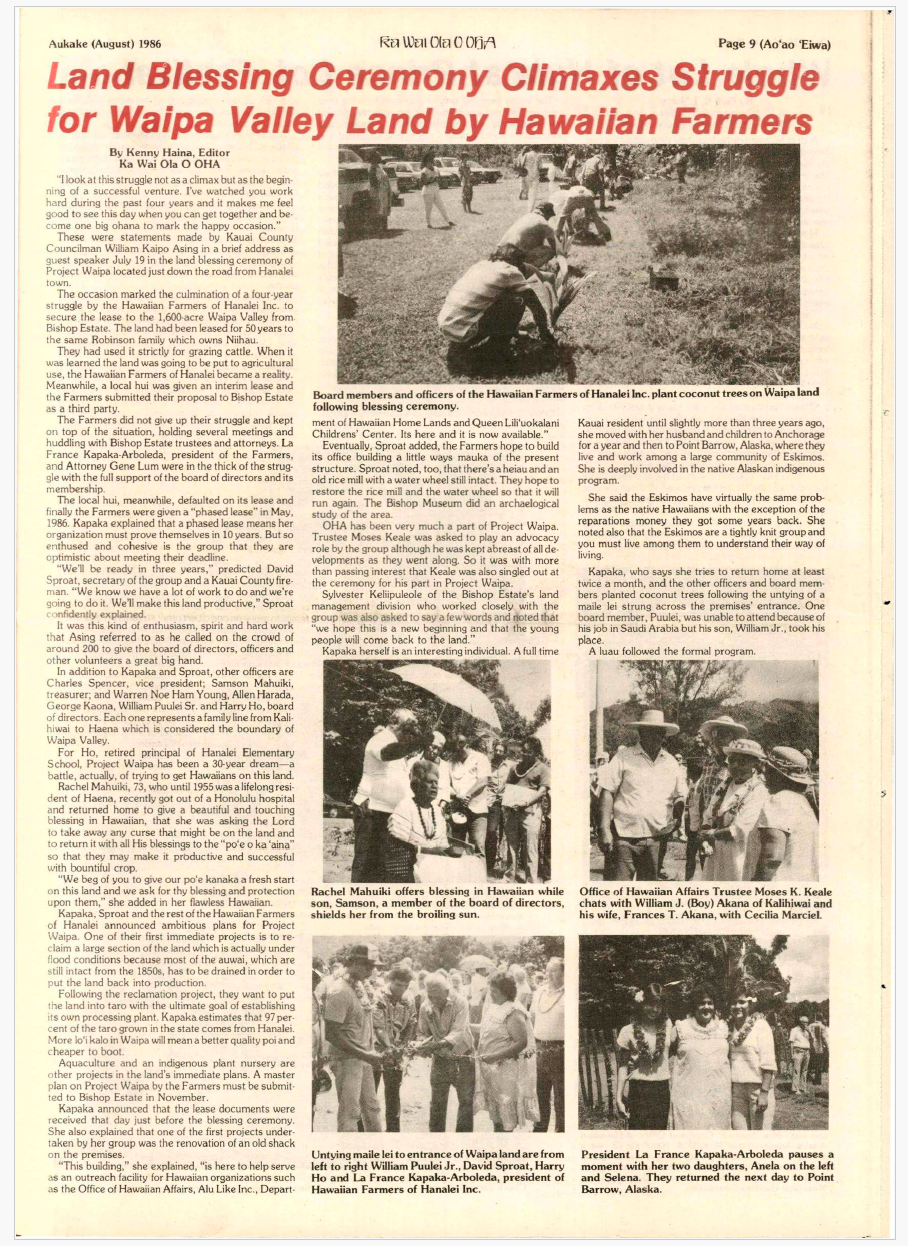
Aunty LaFrance Kapaka-Arboleda, a Hawaiian activist from the east side of Kaua’i hears about KS’s development plans and gathers the leaders from the Hawaiian families of the north shore. They create the Hawaiian Farmers of Hanalei, Inc.
1986
After 4 long years of activism, negotiation, and the default of the developer and potential lessee,the HFOH win the lease for the 1,600 acre ahupua’a of Waipā.
1986
Members of HFOH begin restoring Waipā, developing and implementing their mission and exploring what it means for a community to manage an ahupua’a. Thursday poi days begin with kūpuna and volunteers, Tuesday farmers market is started, and groups of cultural practitioners from all over Hawai’i visit and partner with HFOH to lead cultural workshops.
1992
Hurricane Iniki decimates Kaua’i, destroying 80% of Waipā’s buildings and damaging a significant area of the upland native forest.
1994
Waipā Foundation is incorporated by founding board members Hau’oli Wichman, Carol Ann Washburn, Linda Sproat, Bernie Mahuiki, and Stacy Sproat. A master plan for Waipā is completed by them and Kathleen Cook.
2000
KS begins implementation of its strategic plan that includes mandates to manage their lands as Legacy Lands for conservation, education, and culture.
KS and Waipā begin a partnership and receive initial funding for the Waipā Ahupua’a Learning Center, initiated by Neil Hannahs, Charlene Hoe, and Stacy Sproat. Stacy steps off the board of the Waipā Foundation and assumes the role of Executive Director, its first paid staff.
2002
An archaeological survey and inventory is completed for the lower valley of Waipā by archaeologist Tom Dye and UH archaeology professor Bion Griffin. The project is funded through a federal grant written by Dr. Adam Asquith, an entomologist and strong supporter who helps to develop Waipā’s programming over the course of several years.
2003
Waipā Foundation is granted its 501c3 status and the strategic plan is completed.
2004
Waipa’s 20 year Site Plan and Development Program by planning consultants Townscape, Inc. is completed. With funding from KS and other donations, planning begins on the development of Phase I of the Community Complex. Ryan Like, Kari Shozuya, Lea Weldon, and Nanea Sproat arrive as UH HIP and Stream Learning Center interns.
2005
Waipā Foundation takes over the master lease for the ahupua’a of Waipā for a term of 15 years.
2006
Waipā begins fundraising, permitting, and development for its certified kitchen, poi mill, and hale imu building. OHA funded business plan and feasibility study for the commercial kitchen and poi mill are completed.
2007
Waipā completes its 20 year Agricultural Master plan funded by OHA and KS. One of the first grants we received was a $300,000 OHA Trustee Discretionary grant, for design and construction of our kitchen, poi mill, and hale imu.
2011
The Waipā Stream Restoration Project was initiated and developed by Matt Rosener.
2012
Roughly 4,000 learners are served annually with funding from KS, Hau’oli Mau Loa Foundation, the Hawai’i Community Foundation, and other private donors. The groundbreaking ceremony is held on June 8th. Hundreds of fruit trees are planted, removal of hau bush from the stream site is started, and the camping program is established.
2013
Keanolani Hale is completed and the facilities are opened to community use. Waipā completes the multimillion dollar capital campaign for the Laukupu Commercial Kitchen and Hale Imu with a $200,000 GIA grant from the state legislature.
2013
KS and Hau’oli Mau Loa Foundation invest significantly in Waipā and other community organizations to create enrichment programs for historically underserved families from the local community. KS and Waipā complete negotiations for a 45 year lease through 2050.
2014-2015
Waipā completes contracting, permitting, and construction of the Laukupu Commercial Kitchen, Poi Mill, and Hale Imu. In 2015, the facilities open for use by Waipā and local food entrepreneurs.
2017
In 2017, poi operations move over from the old poi garage to Laukupu Poi Mill with 800 lbs a week of poi production.
2017
After 20 years of ‘āina management, program participation reaches an all time high with afterschool, summer, and intersession breaks as Waipā welcomes over a thousand learners per year. Waipā builds community engagement through its Kalo and Mango festivals and Eat the Invasives dinner series.
2018-2019
In April 2018, Waipā records a national record of 50in of rainfall in 24hrs. With its strategic location and dedicated staff, Waipā supports various initial flooding relief efforts while continuing to produce and distribute healthy locally grown food to impacted community members.
2020
CARES act funds through the County of Kaua’i facilitates the removal of invasive species on 9 acres of future agroforestry and lo’i areas.
2020
Waipā poi cheesecake, a signature product, is developed and launched.
2021
Waipāʻs self serve, honor system kiosk becomes a significant source of food for the community.
2021
Major rains cause the Hanalei Hill landslide on March 11th, completely cutting off access. Waipāʻs staff and volunteers on the Hanalei side process 800lbs of poi, transporting it across Hanalei river by boat to make the regular deliveries from Kalihiwai to `Ele`ele.
2022
Mission aligned groups are welcomed back through field trips, group visits, and intern programs. Cultural and `āina practitioners are also eagerly welcomed back, with the inaugural MĀLA `ŌIWI gathering of agroforestry practitioners from around Hawai`i.
2022
The popularity of Waipāʻs poi cheesecake developed in 2020 explodes with sales topping $100K annually.
2023
Grants are awarded to fund the Stream Restoration Project, a new Coastal Resiliency Project, farm and food tours, and Kūlia I Ka Nu`u, an intern program targeting college age youth.
2024
2024 is Waipāʻs 30th birthday. The Trust for Public Land helps facilitate the acquisition of a quarter acre kuleana parcel along Halulu fishpond, securing Waipāʻs perpetual right to `āina. A blessing is held on March 2nd to celebrate the 10 years of work on the acquisition.


